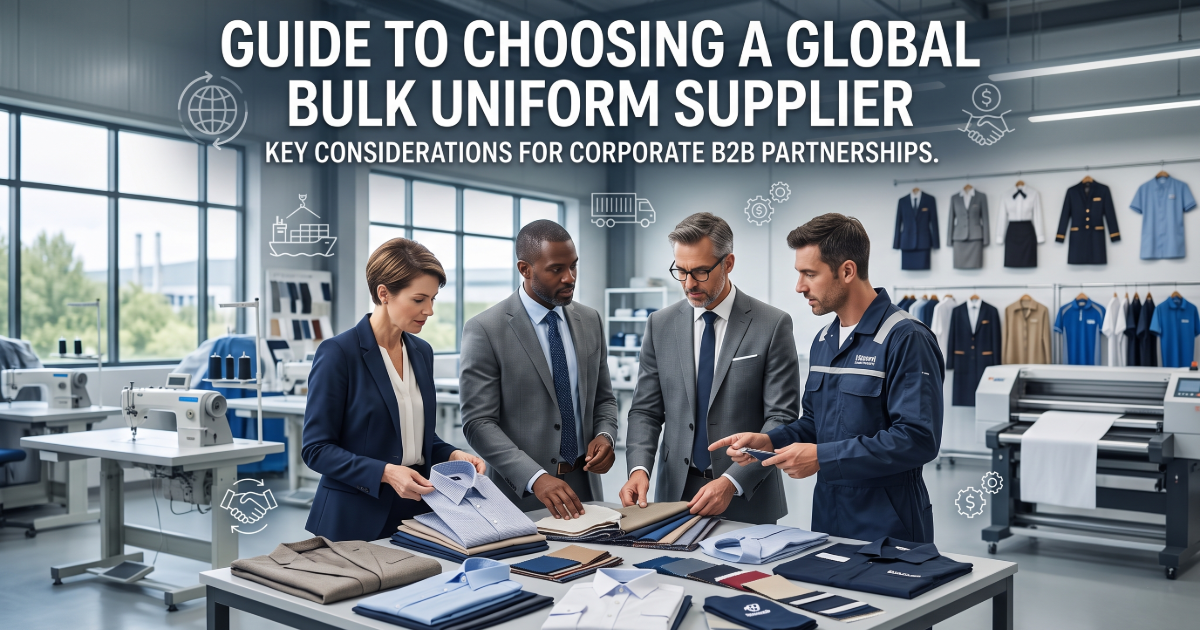
Struggling to pick the best global bulk uniform supplier? Our definitive guide simplifies selection, helping you find the ideal partner and avoid costly errors.
Selecting a strategic partner for bulk uniform manufacturing is a critical operational decision. Whether you are outfitting a hospital network of 2,000 professionals, a multi-city hotel chain, or a geographically dispersed security workforce, your chosen supplier directly impacts your brand equity, employee performance, and long-term procurement budget.
Too often, organizations make vendor decisions based on initial pricing alone—a miscalculation that frequently results in compromised fabric integrity, delayed deployments, and accelerated replacement cycles.
To ensure a high-ROI procurement process, organizations must evaluate partners systematically. Here is a comprehensive framework for vetting a bulk uniform manufacturer before issuing a purchase order.
1. Prioritize Industry-Specific Manufacturing Expertise
A manufacturer that simultaneously produces garments for healthcare, hospitality, academia, and corporate sectors possesses a strategic advantage over generic apparel factories: a deep understanding of industry-specific functional requirements.
Healthcare & Clinical: Require industrial-grade scrubs engineered to withstand high-temperature sterilization and harsh chemical disinfectants without structural or chromatic degradation.
Hospitality & Culinary: Demand uniforms that maintain a crisp, premium aesthetic throughout extended shifts, utilizing climate-adaptable, breathable fabrics.
Security & Industrial: Necessitate high-tensile strength, weather resistance, and strict compliance with high-visibility safety standards.
Academia: Require highly durable, cost-effective scaling to withstand daily wear and tear from active students.
When evaluating a vendor, request localized case studies and product samples specific to your industry, rather than a generalized portfolio.
2. Demand Rigorous Quality Assurance and Global Certifications
Internationally recognized certifications are the most objective metric for distinguishing established, tier-one manufacturers from unverified third-party resellers.
ISO 9001: Demonstrates a legally documented, standardized quality management system governing the entire production lifecycle.
OEKO-TEX® Standard 100: Certifies that textiles have been rigorously tested against harmful substances—an essential compliance factor for garments worn directly against the skin for prolonged periods.
MSME Registration & FIEO Membership: (Particularly for Indian exporters) validates the supplier as a legally recognized, government-vetted export entity rather than an unregulated intermediary.
Do not accept verbal assurances; mandate official certification documentation during the RFP (Request for Proposal) stage.
3. Assess Advanced Material Science and Fabric Architecture
The textile composition is the ultimate determinant of a uniform’s lifecycle ROI. A premier supplier operates as a consultant, guiding procurement teams through fabric weights, weave structures, and advanced synthetic blends tailored to the operational environment.
For instance, hospitality staff require moisture-wicking micro-blends for thermal regulation, whereas clinical environments demand reinforced poly-cotton twills built for extreme wash frequencies. A supplier limited to generic, off-the-shelf fabrics lacks the manufacturing sophistication required for enterprise-level deployment.
4. Evaluate Precision Customization and Brand Alignment
Uniforms serve as the most visible physical extension of your corporate identity. Before committing to a production run, meticulously audit the supplier’s customization capabilities:
Can the facility match exact Pantone/HEX brand guidelines, rather than settling for "approximate" shades?
Do they offer advanced application methods (e.g., high-density embroidery vs. sublimation printing), and can they articulate the longevity of each?
Is there a formalized design-proofing and physical sampling protocol prior to mass production?
What are the Minimum Order Quantities (MOQs) for highly bespoke architectural designs?
Suppliers that integrate 3D prototyping and interactive design approvals drastically mitigate the risk of costly misalignments during bulk production.
5. Verify Scalable Production Capacity and Reliable Lead Times
For enterprise procurement, theoretical capacity is irrelevant; proven, scalable output is mandatory. An authoritative supplier must provide transparent, data-backed metrics regarding:
Maximum verifiable monthly and quarterly output volumes.
Realistic, contractually binding lead times tailored to your specific order magnitude.
Agility protocols for handling sudden mid-production scale-ups or emergency uniform replacements.
Standardized Quality Control (QC) checkpoints implemented across massive production runs, ensuring unit 10,000 matches unit 1.
Approach vague delivery estimates with high skepticism. A capable facility will provide precise Gantt charts and production schedules, not empty reassurances.
6. Scrutinize Global Supply Chain Logistics and Export Proficiency
For international procurement, superior manufacturing must be paired with flawless logistics. Delivering the product intact, compliant, and on schedule is half the operational battle.
Does the vendor possess documented experience navigating the customs and import compliance regulations of your specific destination country?
Do they partner with tier-one global freight forwarders offering end-to-end tracking and insured transit?
Is there a legally sound SLA (Service Level Agreement) detailing defect resolution or transit-damage policies?
A manufacturer with an established global logistics network inherently minimizes the risk of costly port delays or customs impoundments.
7. Analyze Verifiable Track Records and Client Retention
While client testimonials provide baseline validation, the granular details dictate a supplier's true reliability. Look beyond generic praise and seek out verifiable data points: order volumes, geographic deployment, industry alignment, and most importantly, client retention rates. A manufacturer boasting multi-year, recurring contracts with global enterprises is an infinitely safer investment than one with numerous one-off transactional reviews.
8. Insist on Transparent Financial Structures and Contractual Clarity
Enterprise bulk pricing must scale transparently. Before initiating capital transfers, secure absolute clarity on the following financial parameters:
Exact volume-based tier thresholds and subsequent unit cost reductions.
A comprehensive breakdown of landed costs (separating base manufacturing from customization, freight, tariffs, and taxes).
Clearly delineated payment terms, milestone deposits, and international letter of credit capabilities.
Post-deposit "hidden fees" are the hallmark of amateur sourcing. A professional manufacturer provides an exhaustive, binding quotation upfront, ensuring zero financial surprises.
The optimal uniform manufacturing partner is rarely the one offering the lowest initial bid. It is the institution that comprehensively understands your operational challenges, guarantees quality through global certifications, executes precise brand customization, and wields the logistical infrastructure to deliver at a global scale. Investing the due diligence to vet your supplier against these stringent criteria will ultimately yield a higher standard of product, a stronger brand image, and a significantly optimized total cost of ownership.
Are you ready to elevate your organization's professional presence? Request a comprehensive corporate quotation from Cyrus Uniform today, and discover how our ISO 9001-certified global manufacturing capabilities can seamlessly scale with your enterprise.